
Women in the Collection: Histories of Womanhood at Museo Ottocento Bologna

Museo Ottocento Bologna has been committed to uncovering the history behind the works of female artists in exhibitions hosted at the museum, such as the ones dedicated to Carotta Gargalli (1788 – 1810) or Lea Colliva (1901 – 1975), as well as in the research work of the Museum Director Francesca Sinigaglia.
This article aims to valorise the presence of women within and behind the works of the collection of Museo Ottocento Bologna, focusing on the stories of the women inside the collection as well as the history of women in the 19th century. Social changes impacted women in the 19th century, from their confinement to the domestic space to their emerging autonomy in the public space, notably as working women and professional artists, such as Giulia Rizzoli and Emma Bonazzi. Combining close visual analysis with feminist art historical approaches, and drawing on the work of Griselda Pollock (1949 – ), Linda Nochlin (1931 – 2017) and John Berger (1926 – 2017), the article considers a selection of works from the collection to offer an inclusive and feminist-informed reading of the collection.
Womanhood and the domestic space
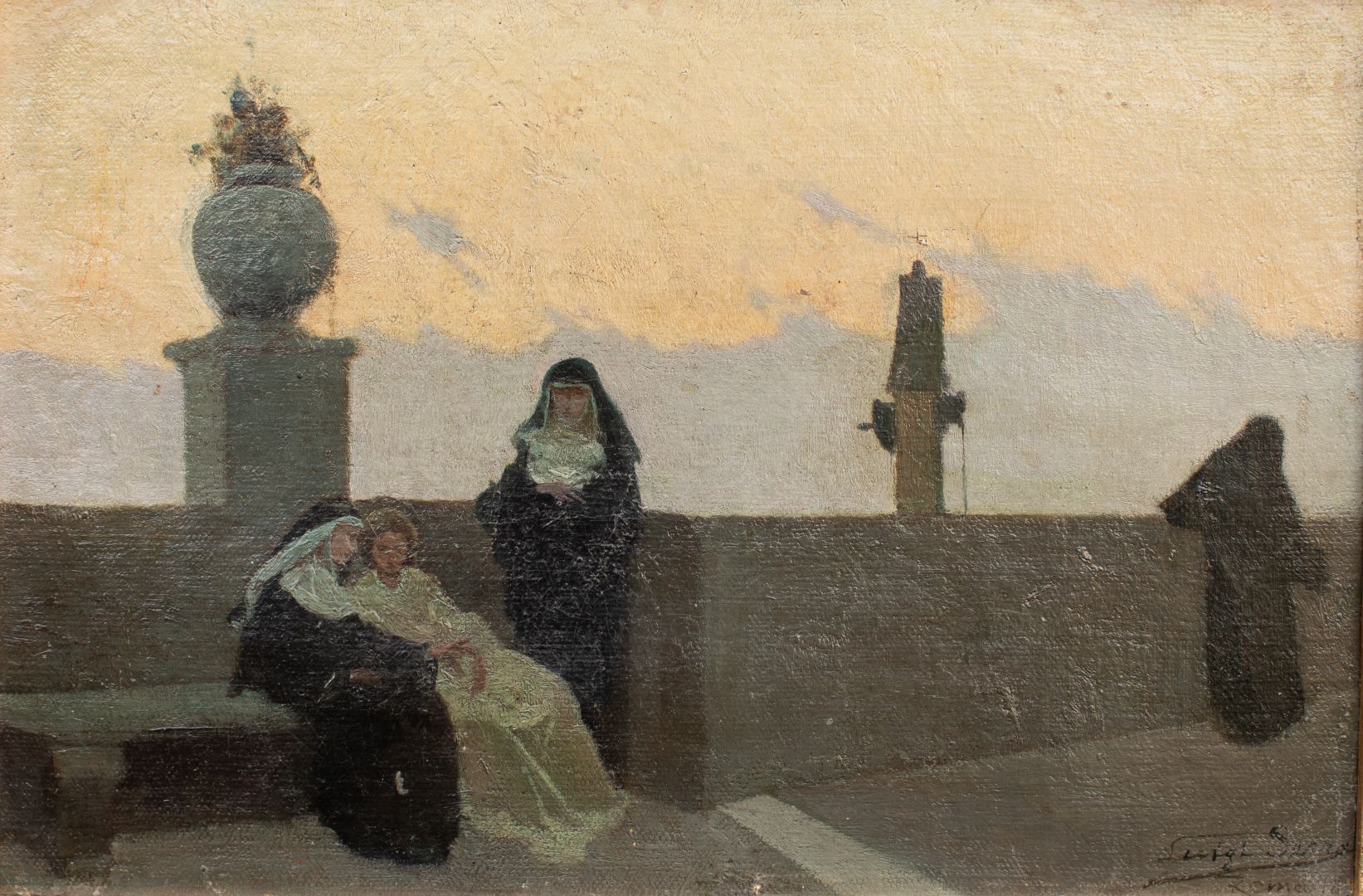
In the Ottocento, Europe’s social conditions were changing, notably with the Bourgeoisie becoming the dominant class across Europe. From that social and economic change follows a set of social norms, asymmetrically affecting women and men. In her chapter “Modernity and the Spaces of Femininity,” Griselda Pollock argues that at the time, women were expected to remain in the private domestic space while men explored the public spaces, and more specifically, urban spaces. Pollock adds that for women the public spaces generated a risk, as it was “not only frightening because it became increasingly unfamiliar, but because it was morally dangerous.” (Pollock, p.97). Therefore, a woman’s respectability could be challenged when she would present herself in the public space alone: “[f]or women, the public spaces thus constructed were where one risked losing one’s virtue, dirtying oneself. It has been argued that to maintain one’s respectability, closely identified with femininity, meant not exposing oneself in public.” (Pollock, 97) This is illustrated in the work of Luigi Serra (1846 – 1888), Le confidenze (1882) (Fig. 2), in which we see a woman outside confessing among a group of respectable religious nuns. Despite the intimate, meditative and sacred character of the painting, we see a woman outside in a public space confessing, as if her presence in the public space is forbidden and she must redeem herself, to regain her virtue. In the painting, the woman’s outdoor presence is rendered morally accepted as she is confessing and is surrounded by the moral presence of the nuns. Although the woman is outside in Rome, she is confined by a wall, separating her and the nuns from the rest of the city.
The confinement of women in the domestic space is notably rendered visible in a couple of works of the collection. The painting of Alfonso Savini (1838 – 1908), La serenata (s.d.) (Fig.2) exhibits that confinement with a visible contrast between the indoor space and the outdoor space. We see a woman being seduced by a man playing music for her, as she stands in front of the window, facing the indoor space. The framing of the windows, with the pilaster in the middle, blocks the access to the outside world, subtly. The woman is not looking out, but in, while the man probably entered from the window, the outside, to come play his serenata. An interesting detail echoes the domesticity of that aristocratic woman, which is her lace work, which women would dedicate hours to. This textile work has been overlooked in art history, and not considered as art, but craft, despite the work and precision it requires. In a sense, one could argue that Savini, through his oil, is flaunting his academic and recognized work by contrasting it with the overlooked, abandoned craft work of the depicted woman. Yet, painting was also practiced by women in the home, to keep themselves busy as a leisure activity. This is rendered visible in the painting by Gaetano Pallozzi (1832-1892) , La pittrice di fiori (1873). Here, a woman is depicted in the action of painting in an interior space, presumably a domestic space. She is painting flowers. Flowers were the subject reserved for women enjoying painting as a pastime. The flower subject is considered decorative and not “art”, and has been overlooked by art history notably because of its association to women, as women too were overlooked and reduced to amateurs, rather than considered legitimate artists. In her essay Why Have There Been No Great Women Artists? Linda Nochlin discusses how women have been systematically left out of the canon because of structural misogyny in the disciplines of art history and fine arts.
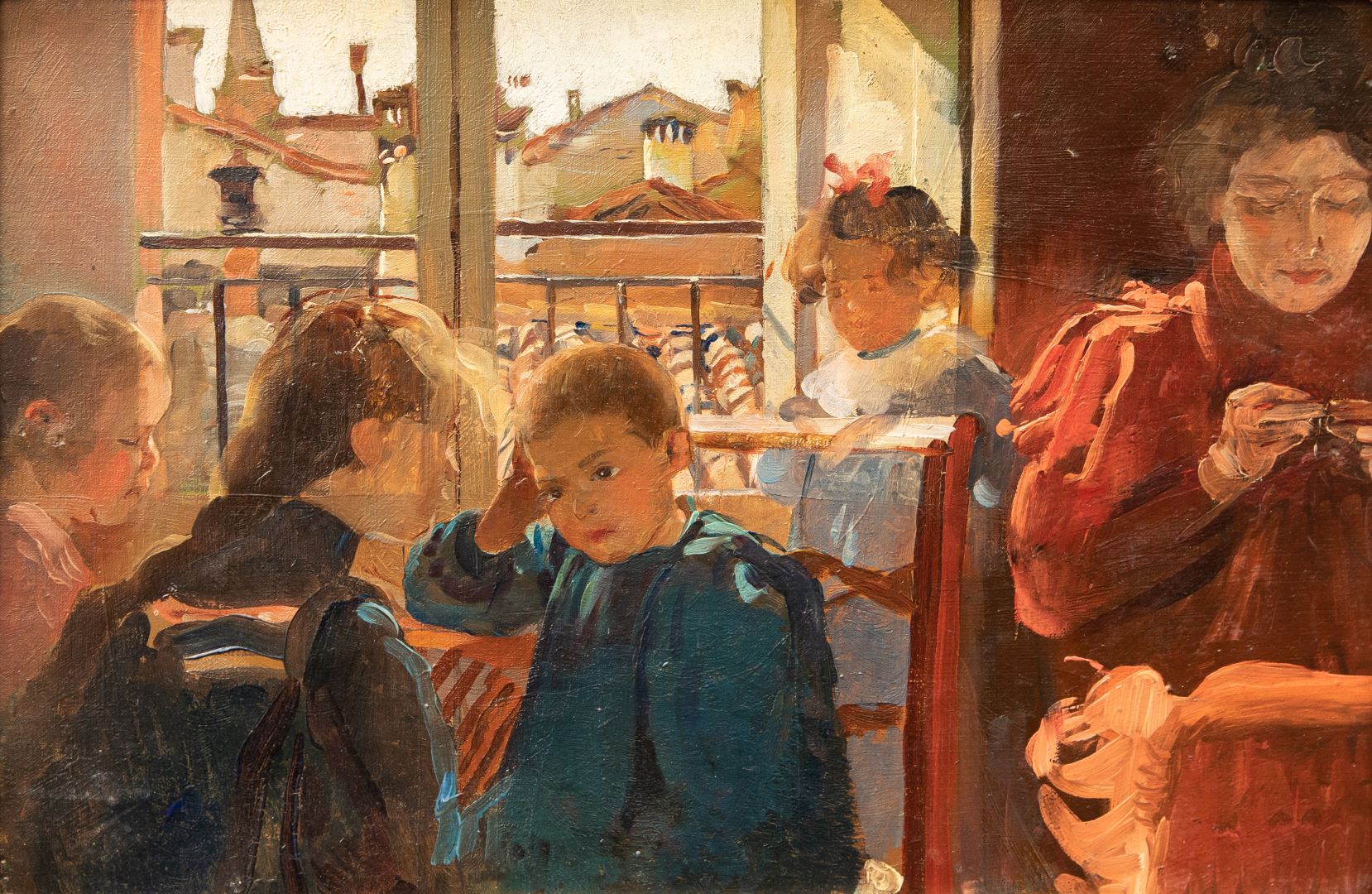
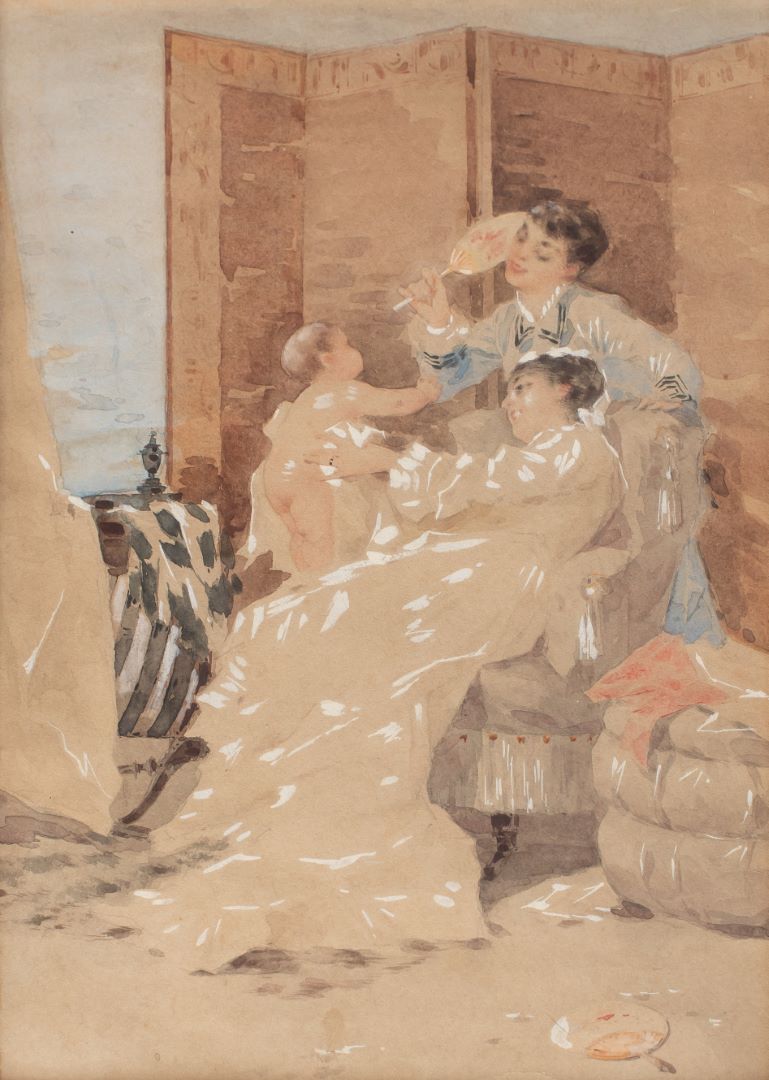
The confinement of women inside the home is interwoven with motherhood. Jane Gallop writes: “The home is a heaven of privacy, protected by the public eye by the right of privacy. Motherhood is immured in the home” (Douglas, p. 2). This fact, of motherhood being reserved to the home, is illustrated by the intimate scene of Luigi Busi (1837 – 1884)’s work Le gioie materne (s.d) (Fig. 4) depicting a mother and a female helper playing with a newborn. The mother inside the home is also depicted by Alessandro Scorzoni (1858 – 1933) in his work La mia famiglia (1898) (Fig.3), a family portrait depicting his wife and their children in poor economic conditions. The woman is again engaged in some textile work (in this case knitting), indoors, in a room filled with four children. Here, Scorzoni encapsulates a regular, intimate moment of his family, notably the role of the woman in the domestic space: to care and mother. Surprisingly, although the female confinement of the domestic private space is related to the family and the role of the woman as mother, the story behind that mother knitting is the one of a woman who decided for herself and her children: she went out in the world. She decided to leave her husband behind to go live overseas, hoping to find better living conditions in America.
Women outside (the box)
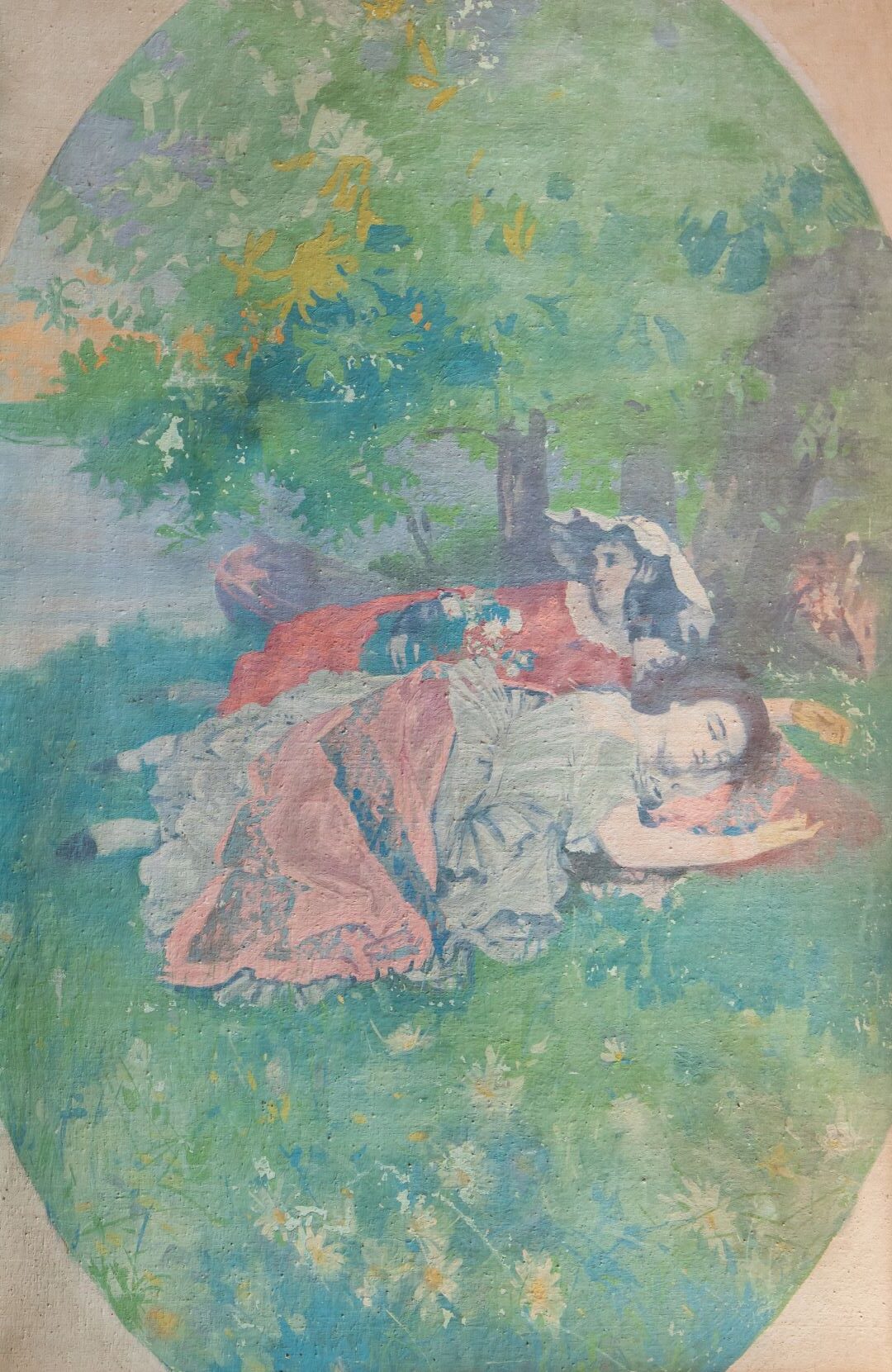
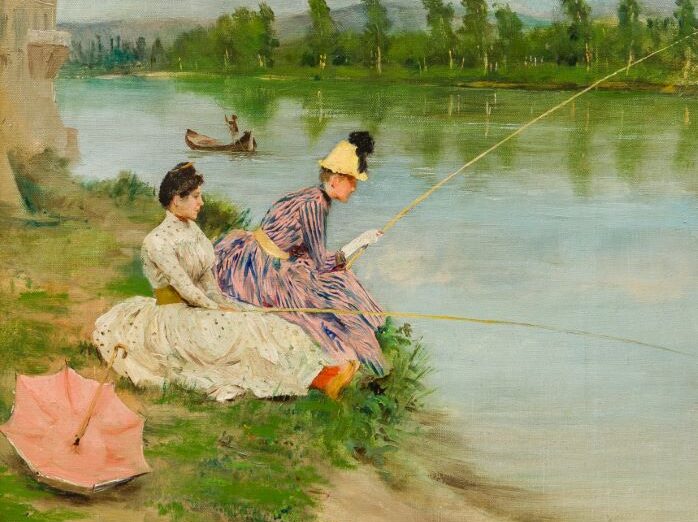
Aside from Serra’s work Le confidenze (1882), the collection holds other depictions of women outside the domestic space. We find a number of works representing the presence of women in nature. Nature, unlike the urban space, is a space in which women can find themselves. Indeed, women have been considered an extension of nature, as belonging to nature, notably because of their childbearing bodies. For example, women leisuring in nature is rendered visible in the work of Alessandro Scorzoni, Sul greto dell’Indice (1932) (Fig. 5) depicting two women relaxing on the grass near the water (back of the painting). Another depiction of well-dressed women on the grass is the work of Fabio Fabbi Pescatrici sull’Arno alla Casareccia di Bellariva (1887)(Fig.6) in which two women are depicted fishing. Unlike hunting, fishing was considered an acceptable occupation in nature for women, allowing them to escape the domestic space and enjoy nature: “Though nineteenth-century middle- and upper-class white women were limited in their access to the natural world by scientific and cultural views of gender, many discovered that angling afforded unique opportunities to explore and engage nature through the overlapping roles of tourist, naturalist and conservationist.” (David McMurray). Although Fabio Fabbi (1861 – 1945) is famous for his travels and orientalist gaze of North Africa and sexualizing gaze of North African women, in this depiction of these fishing women, he offers a refreshing perspective on middle-class women. Despite practicing a respectable activity at the time, a sense of freedom, outside the home, vibrates.
On the threshold, between the inside and outside space, a woman stands on the balcony, accompanied by the shadow-like presence of a man. Marcello Dudovich (1868 – 1962) depicts Elisa Bucchi (1880 – 1945), under the twilight in Piazza San Domenico in his Autoritratto con Elisa Bucchi (1899-1901). Elisa Bucchi was known as Dudovich’s muse, notably for advertising illustrations, yet she was also a recognized working woman and single mother. She worked in the field of journalism as a fashion correspondent as her taste and knowledge of fashion was recognized at the time. She also wrote a column Le Eleganze della Moda for the magazine Ars et Labor. Dudovich, the successful illustrator, in this portrait of him and her, places himself in the back, behind her, almost unrecognizable. The light work highlights the presence of Elisa and one could recognize her features. One is invited to look at her not like a trophy wife, a famous model, but through an admiring gaze, the one of her admirator. Elisa is not looking at the spectator, neither at him, she is looking down, immersed in herself as the night allows, she is oneself and not someone else’s.
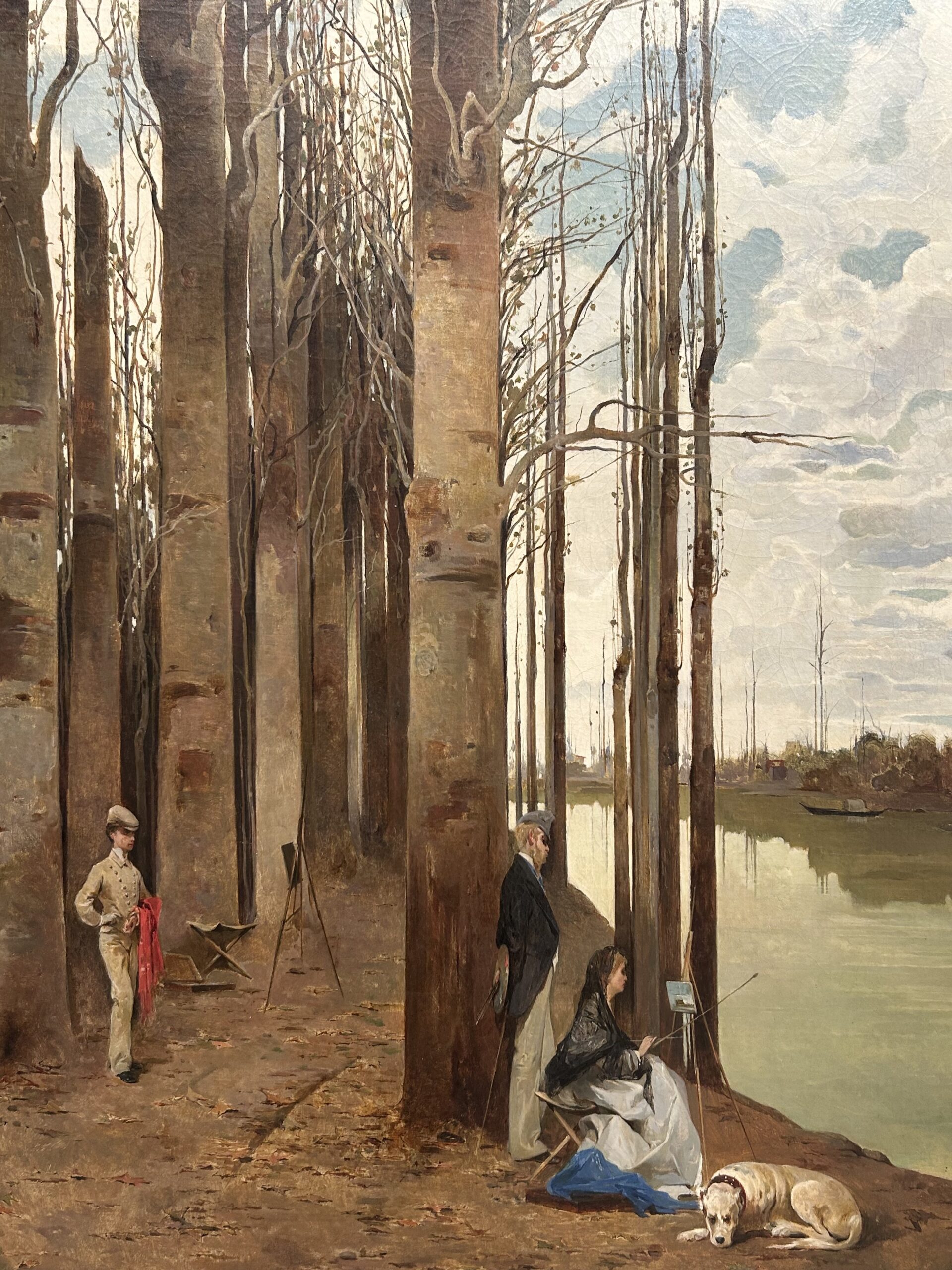
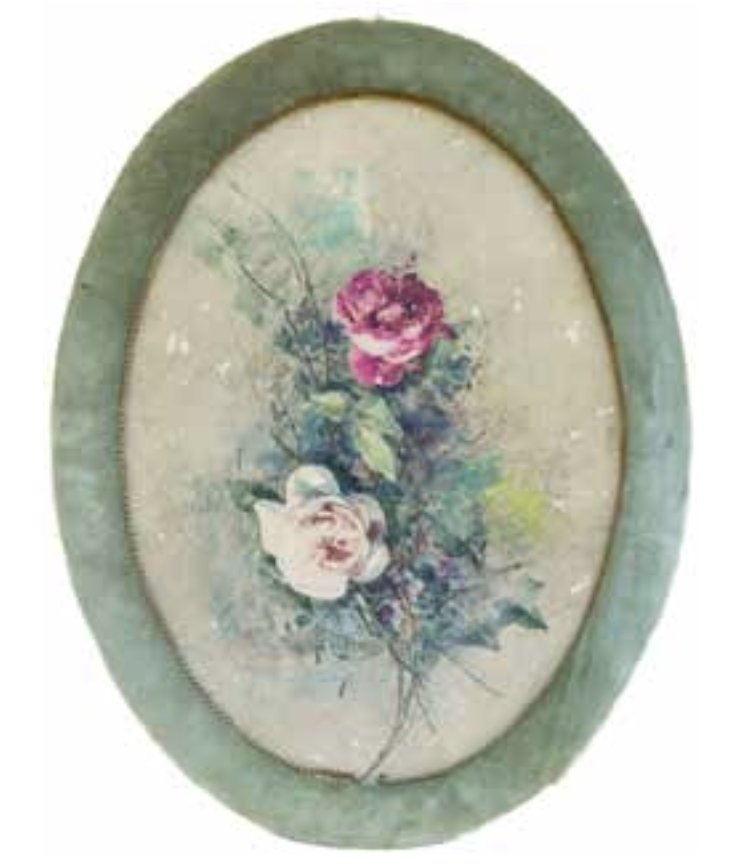
In a similar way, in a self-portrait entitled Ultimi sorrisi d’autunno (1874) (Fig. 7), Raffaele Faccioli (1845 – 1916) depicts himself and his wife, Giulia Rizzoli (1857-1890), painting outside. Although this painting showcases a male gaze, with a husband standing and overseeing the art production of his wife, sitting at her easel, it showcases a modern vision. It shows a man encouraging his wife’s work, a couple sharing the love of painting and practicing together in a new way, en-plain-air. Rizzoli is depicted in the action of painting; his husband, despite his authoritative posture, depicts his wife with agency and in the action of working. Until now, Rizzoli has been thought to not have painted professionally, but her work was still recognized, notably her impressive drawing techniques. However, the archive shows that Rizzoli was indeed a professional artist as two of her works, Stanchezza and La lettura al nonno, were exhibited at the Esposizione Nazionale di Belle Arti in Bologna in 1888.
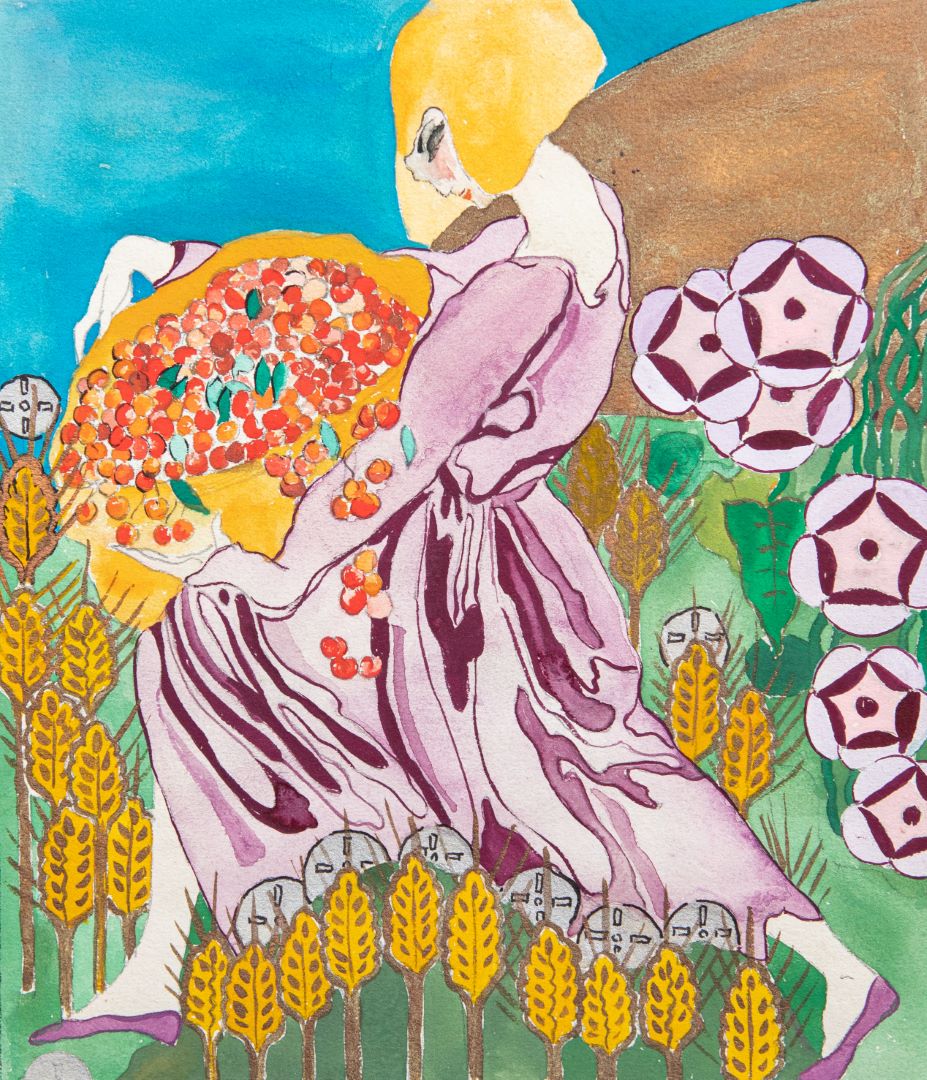
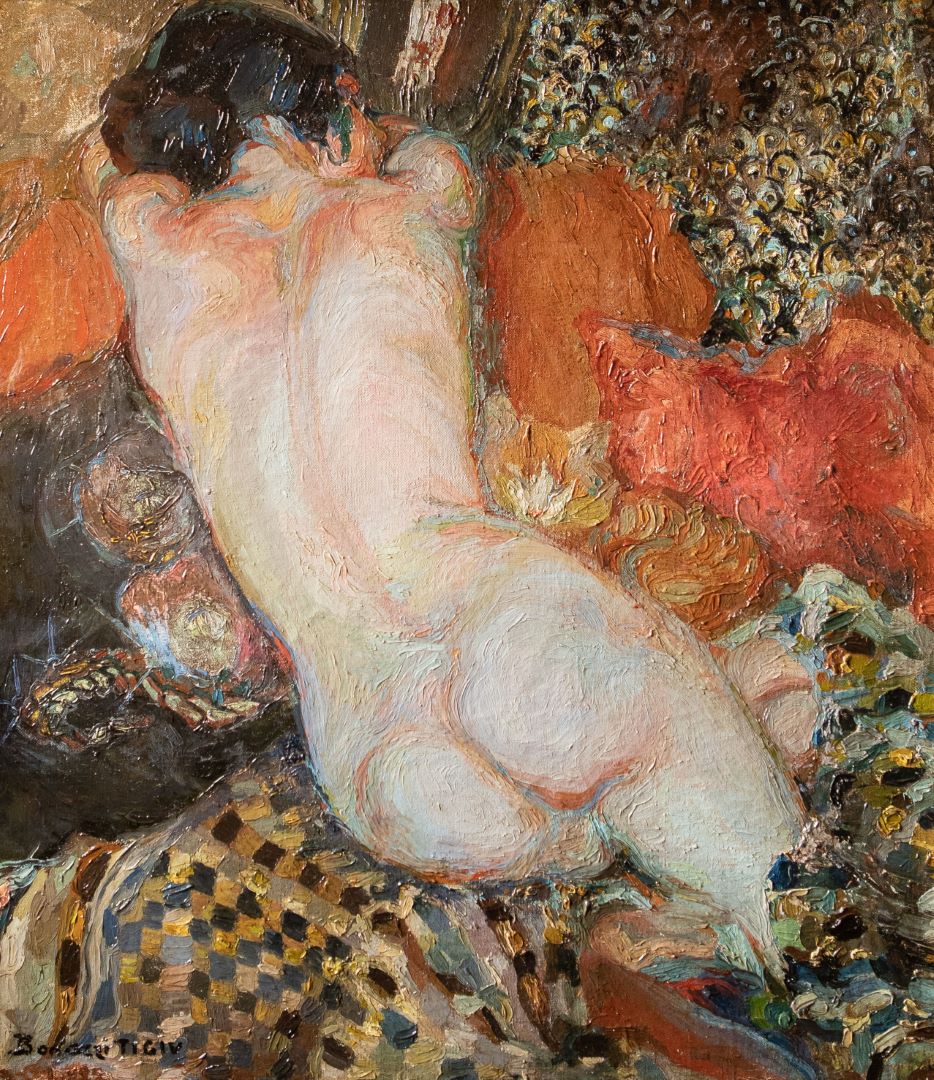
Emma Bonazzi (1881 – 1959) was also a working woman, a professional painter and illustrator, notably for the chocolate company “La Perugina” and the pasta brand “Barilla”. She is also known for mastering diverse art techniques and mediums. Bonazzi’s expression is plural and explorative, a secessionist, who breaks away from the archaic male-dominated art history. Her mastery of drawing and illustration is showcased in the collection with her work The seasons (1917) (Fig.9), with six water colours depicting allegories of the months. Those watercolours exhibit the visual and symbolic sensitivity of the artist in which women embrace nature and its seasons. In other words, these aquarelles demonstrate the poetics of Bonazzi and a female gaze on nature and the female body. Her vision of the female body is exhibited in the collection in a naked female body depiction (to not call it nude), Giovinezza (1922) (Fig.10). This painting is approached with a rich decorative klimt-like inspiration as well as a variety of textures. The visible, at times becomes hardly visible, such as the orange cat, hiding near the woman’s hips. This is thus challenging the viewer, who has been historically put in an advantageous position, for whom the image unfolds, for whom the female naked body is a fully revealed, accessible, objectified body. Berger, in his essay Ways of Seeing, reminds us: “To be naked is to be oneself. To be nude is to be seen naked by others and yet not recognized for oneself.” (Chapter 3). In the case of Bonazzi’s depiction of the naked female body, she recognizes that the depicted woman is to be herself. The viewer can see the woman’s hair, back, some parts of her legs, her glutes and a bit of her profile. The artist doesn’t give all access to the female body, in contrast to Fabbi’s Room of pleasures, for example, she shows a degree of privacy, modesty that moves away from the sexualizing tradition of the nude, allowing the nakedness of the depicted woman to belong to oneself, to be hesr. Sensuality remains, but the artist complexifies the gaze on the naked body through textures and colour. The artist stresses the naturalism of the female body, its nakedness, moving away from erotic imagery, breaking away from the nude tradition. The woman’s skin is uneven, her glutes sag, the shoulder muscles are visible, and the ribcage perceptible. Her brushstrokes are visible in the work of her skin which illuminates the unhomogeneous and lively nature of her female skin, its different textures and volumes.
Another successful female painter present in the collection is Sonia Micela (1924 – 1988). The collection holds a portrait of her (1956) made by Amleto Montevecchi (1878 – 1964). Montevecchi depicts the female artist well dressed with her palm on her chest, a gesture that points to her identity as a woman of value. Sonia Micela was a woman artist dedicated to the artistic scene of Emilia-Romagna, but also to the anti-fascist movement during the war. Sonia Micela’s dedication goes beyond her visual expression: she is a woman who invested herself outwards, in the society, on a cultural and social-political level.
Ultimately, the Museo Ottocento Bologna’s collection reveals a rich history of women in the 19th and 20th century in Emilia Romagna. From women enclosed in the domestic interior to their presence in the public space, from their roles of mother and muse to that of working women and artists, the condition of women is changing and is taking a turn in the Ottocento, as they challenge patriarchy.
About the author
Inès Abou Zeid graduated from McGill University in June 2024 with a Bachelor of Arts in Art History and double minors in World Cinema and South Asian Cultural Studies. She is currently pursuing a Master’s degree in Arts, Museology and Curatorship (AMAC) at the University of Bologna. As part of her Master’s programme, she completed an internship at Museo Ottocento Bologna between June and September 2026. She is pursuing opportunities in the cinema and visual art sectors, where she can continue learning while contributing her skills to projects that promote inclusive, thoughtful, and socially engaged cultural practices. Shaped by a multicultural background and a personal artistic practice, Inès values openness, dialogue, and critical engagement. She approaches art in its diverse forms as a window onto the world, helping one to see it more clearly and to understand oneself more deeply.
LinkedIn: Inès Abou Zeid
List of Figures
Fig. 1. Alfonso Savini, La serenata, s.d., olio su tavola, 33 × 27 cm, Museo Ottocento Bologna.
Fig. 2. Luigi Serra, Le confidenze, 1882, olio su tela, 23 × 35 cm, Museo Ottocento Bologna.
Fig. 3. Alessandro Scorzoni, La mia famiglia, 1898, olio su tela, 21 × 31 cm, Museo Ottocento Bologna.
Fig. 4. Luigi Busi, Le gioie materne, s.d., acquerello su carta, 36 × 26 cm, Museo Ottocento Bologna.
Fig. 5. Alessandro Scorzoni, Sul greto dell’Idice, 1932, olio su tela, 140 × 210 cm, retro, Museo Ottocento Bologna.
Fig. 6. Fabio Fabbi, Pescatrici sull’Arno alla Casaccia di Bellariva, giugno 1887, olio su tela, 43 × 32 cm, Museo Ottocento Bologna.
Fig. 7. Raffaele Faccioli, Ultimi sorrisi d’autunno, 1874, olio su tela, 90 × 63 cm, Museo Ottocento Bologna.
Fig. 8. Giulia Rizzoli, Fiori, s.d., olio su tela, collezione privata.
Fig. 9. Emma Bonazzi, Le stagioni: Giugno, 1917, acquerello su carta, 21 × 18 cm, Museo Ottocento Bologna.
Fig. 10. Emma Bonazzi, Giovinezza, 1922, olio su tela, 97 × 86 cm, Museo Ottocento Bologna.